 SkyLit
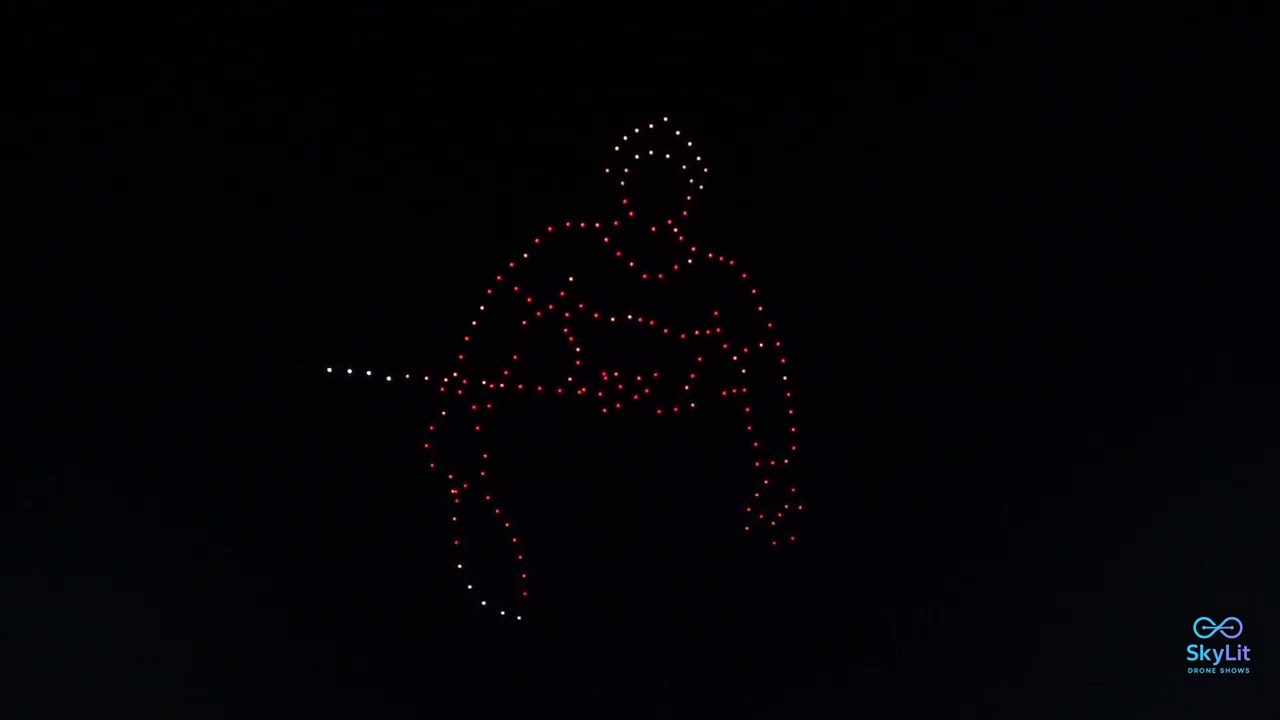
Nagar Palika Asind came to us with a brief that was really a constraint. Dussehra at Asind, in Bhilwara district, already has its ending: the Ravan Dahan, the effigy burning on the mela ground, the thing everybody has come for. Whatever went in the sky could not compete with that, and it could not be a separate attraction bolted on beside it. It had to arrive at the same place at the same time.
A Story Everyone Already Knows
That turned out to be the useful part. At a wedding we are usually introducing people to two names they may not know how to spell. At Asind the audience knew the story better than we did. Nobody needed a caption under Hanuman. That freed the show to move quickly and to lean on recognition rather than explanation, which is exactly what you want when the thing is only a few minutes long and people are watching it standing up.
We storyboarded the Ramayana into sixteen scenes, in order, from Shri Ram through the exile, the golden deer, Ashok Vatika and Ram Setu, to Ravana and the arrow. Sixteen is more scene changes than most shows carry. It works here because each figure only has to be on screen long enough to be recognised, not long enough to be studied.
Figures That Read From the Ground
Not every idea survives being drawn in points of light at night. A face does not. A silhouette with a strong outline does. So the scenes that made the cut were the ones with a shape you could identify from a single glance across a crowded field.
The bow is the clearest example. A drawn dhanush is almost all outline, one long curve and a straight line, and it reads instantly from any angle. Hanuman carrying the mountain works for the same reason: the mass of the mountain above the figure makes a silhouette nothing else in the show resembles. Ravana is the opposite problem solved a different way. Ten heads in a row is not a realistic portrait of anything, but it is unmistakable, and it is unmistakable from a long way back.
The Arrow and the Effigy
The moment the whole show was built around is two events in different places. In the sky, Ram takes aim and the arrow goes. On the ground, the effigy is lit. If those two things happen eleven seconds apart, you have a drone show and, separately, a Ravan Dahan. If they land together, you have one event.
So the sequence was cut backwards from the dahan. Ram draws, the bow is held longer than it needs to be, and the release is the cue. After the effigy caught, the sky went to diyas, which is the only part of the show that is not a scene from the story. It is just lamps, held over a crowd that had stopped looking at the fire.
Facing the Right Way
A mela is not a seated audience. People come in from every side of the ground, they stand where there is room, and the good spots are taken hours early by people who are not necessarily in front of anything. A formation has a front and a back, and from the back it is reversed.
Two decisions came out of that. Every formation faced the main body of the crowd, the side where the stage and the effigy were, so the largest number of people got the show the right way round. And the whole thing flew higher than it strictly needed to, around 120 metres, because altitude is what buys sightlines when you cannot control where people stand. Higher costs you a little apparent size. It buys you the far edge of the field.
The Town's Own Name
The show closes on the host. Not a logo, a name: Nagar Palika Asind, written in Devanagari as नगर पालिका आसींद. Devanagari in drone light is harder than Latin script, because the characters hang off a headline bar and the joins matter; letters that merge become unreadable in a way that a wobbly Latin A does not. It needs more drones per character and more spacing than the same phrase in English would.
It was worth the extra. A town that has paid for a show wants to see its own name in its own script, not a transliteration. The scene before it, I ♥ Asind, does the same job in the shorter form people photograph.
Show Night
The mela ran the way a mela runs. The stage had its own programme, the stalls had their own crowd, and the sky show had to start when the ground was ready rather than when the clock said so. The drones went up, the Ramayana ran through its sixteen scenes, the arrow landed with the effigy, and the diyas stayed up afterwards while people took photographs.
See the show page for Asind, with the formations and the film, what goes into a festival drone show, and the full film on YouTube.